
Guard Your Senses
"The five senses are, as it were, five gates, through which all kinds of sin can enter into the soul."


In the final chapter of The Art of Dying Well, St. Robert Bellarmine discusses the sins which enter through our senses. He names these sins and offers remedies.
“In the Sacrament of Extreme Unction are anointed all those parts of the body in which the five senses reside, and in the anointing of each of them it is said: ‘May our Lord forgive thee whatever thou mayest have committed by thy sight, thy hearing, etc.’”
“Hence, we see that these senses are, as it were, five gates, through which all kinds of sin can enter into the soul. If, then, we carefully guard these gates, we shall easily avoid a multitude of sins, and therefore shall be enabled to live well and die well.”
The Eye: Lust

That the eye is a gate through which enter sins against chastity, our Saviour teaches us when He says:
“But I say to you, that whosoever shall look upon a woman to lust after her, hath already committed adultery with her in his heart. And if thy right eye scandalize thee, cut it off, and cast it from thee. For it is expedient for thee that one of thy members should perish, rather than that thy whole body go into hell.” (Matthew 5:28)
⟶ We know that the old men who saw Susanna naked were immediately inflamed with evil desires of lust, and in consequence suffered a miserable death.
⟶ We know also how David, the particular friend of God, from merely seeing Bethsabee washing herself, fell into adultery, and from that into murder, & innumerable other evils.
The Remedy
St. Augustine mentions a remedy in his 109th Epistle, which contains rules for monks: “If you cast your eyes upon anyone, fix them upon no one.”
⟶ A simple glance of the eyes is almost impossible to avoid; but it cannot strike the heart unless it be continued. Therefore, if we do not accustom ourselves to look upon a beautiful woman, and should by chance cast our eyes upon one but then quickly turn them aside, there will be no danger to us; for truly does St. Augustine remark that not in the glance, but in the dwelling, is the danger.
Hence holy Job says: "I made a covenant with my eyes, that I would not so much as think upon a virgin." (Ch. 31) He does not say, "I have made a covenant not to look,” but "not so much as to think" upon a virgin: This means, I will not look too long upon a virgin lest the sight should penetrate my heart, and I should begin to think of her beauty, and gradually to desire to speak with her, and then embrace her.
Advice: accustom your eyes to refrain from sinful objects as if you were blind.
The Tongue: Speech

As for the tongue, unless it is most carefully guarded, is the cause of many evils. St. James teaches that an evil tongue is not merely an evil thing in itself alone, but that it includes a multitude of evils; therefore, he calls it a “world of iniquity.”
1st, to guard the tongue carefully is a most difficult thing; and therefore that there are few, and those only perfect men, who know effectually how to do this.
2nd, from an evil tongue, the greatest injuries and mischief arise quickly.
⟶ By the tongue nearly all crimes are either devised or perpetrated.
⟶ The evil tongue may justly be called “a world of iniquity,” because by the tongue man sins against God by blasphemy or perjury; against his neighbor by detraction, and back-biting; and against himself, by boasting of good works which he has not done in reality; and by asserting that he did not do the evil things which he did (lying)
.
The Remedy
The remedy against evil words is to think beforehand on what we are about to do, or speak, or desire. To guard against sins of the tongue, carefully mind your ways; neither speak, nor think, nor do anything, unless you first examine and weigh what you are about to do or speak. Do not do anything rashly, but consider what is to be done; if it agree with sound reason, do it; but if not, do not do it. And this may be applied to actions, speech, desires, and other works of a rational being.
The Ear: Hearing

There are four kinds of words we must close our sense of hearing to:
Words against Faith (destroys faith, the root of all good)
Detraction (destroys fraternal charity)
Flattery (produces pride and vanity, the queen of all vices and most hateful to God)
Immodest words and songs
The Remedy
Against all these dangers there is a salutary remedy:
1st, to keep with good company,
2nd, to most carefully avoid evil company.
The Sense of Taste
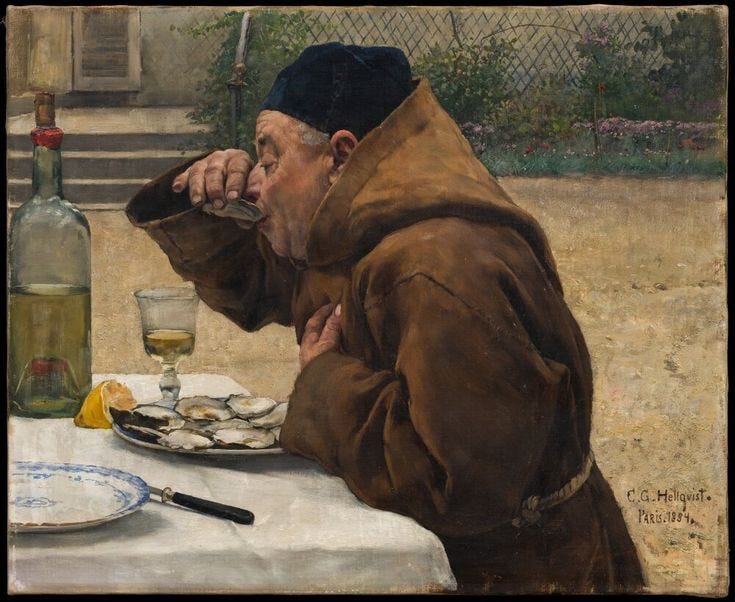
The god of carnal men is “their belly.”
Gluttony and drunkenness are sins numbered in the Holy Scriptures by St. Paul as grievous crimes.
Gluttony and drunkenness injure the health of both soul and body.
They deaden the soul, so as to make it totally unfit for the contemplation of heavenly things.
They obscure our reason, and deprive us of the rays of divine light. As bees are expelled from their hives by smoke, so also the wisdom of God is expelled by revelings and drunkenness.
Too much food and drink are almost the singular cause of every disease (Saint Basil tells us, that he thought “Abstinence” could be called the parent of health)
Drunkenness and revelings not only injure the health of the soul and body, but also our domestic interests:
Loss of wealth → how many have gone from being rich to becoming poor; how many from masters to become servants, by drunkenness?
Greed → This vice deprives many poor people of the alms of the rich; for they who are not content with moderate meat and drink easily spend their whole substance upon their own pleasures, so that nothing remains for their needy brethren.
The Remedy
Look to the example of the saints and to Jesus Christ Himself.
Jerome → considered anything “cooked” as a luxury to a hermit/monk.
Ambrose → fasted every day except Sunday/holy days.
Augustine → ate only herbs and legumes
Israelites → For 40 yrs, God fed them only bread/water
Jesus fed the thousands with a few loaves of bread and fish, and water. After His resurrection, He feasted with his disciples on bread and fish only.
The Sense of Touch

“Now the works of the flesh are manifest, which are fornication, uncleanness, immodesty,”
By these 3 sins, the Apostle includes all kinds of impurities.
“But fornication and all uncleanness, let it not be so much as named amongst you as becomes saints”
The Remedies
Begin with fasting or abstinence. Abstain from eating and drinking too much. (use wine moderately to avoid drunkenness, for in much wine is luxury.)
Physicians give bitter medicine, bleed the body, make incisions, and do other things painful to nature. So did the saints say with the Apostle, “But I chastise my body and bring it into subjection...” Hence the ancient hermits led a life quite opposed to the pleasures and delight of the flesh, in fastings and watchings, lying on the ground in sackcloth and chastisements; and this they did, not so much through hatred to their body, as to the concupiscences of the flesh.
Meditation on the four last things, the mysteries or our salvation, holy scripture, or the lives of the saints.
Again: in order to exercise the body, physicians prescribe walking, playing at ball, or any other like exercise; so also in order to preserve the health of the soul, we ought, if truly desirous of our salvation, to soend some time every day in meditating on the mysteries of our redemption, or the four last things, or some other pious subjects. And if we cannot of ourselves furnish subjects for meditation, we should spend some time in reading the Holy Scriptures, the Lives of the Saints, or some other good book.
Flee idleness.
A powerful remedy against temptations of the flesh and all sins of impurity is to fly idleness; for no one is more exposed to such temptations than he who has nothing to do, who spends his time in gazing at people out the window [or on his phone], or in chatting with his friends, etc. But on the contrary, none are more free from impure temptations than those who spend the whole day in agricultural labors and in other arts.
“Fly idleness if you wish to avoid many sins.” -St. Robert Bellarmine
Reading this, I’m struck by how practical and profoundly spiritual St. Robert Bellarmine’s guidance is. He doesn’t just give abstract warnings; he shows us how our very senses can be both doorways to sin and instruments of holiness if we discipline them. It reminds me that holiness is not some distant, theoretical goal—it’s lived in the small, daily choices: where we look, what we say, what we listen to, how we eat, and how we touch the world around us. The advice on taste and touch also brings home how our bodily lives are meant to be ordered toward God. Fasting, abstinence, careful moderation, and daily labor aren’t about punishing the body....they’re about training it to serve the soul, just as the saints did. It reminds me of how our Catholic faith integrates the body and the spirit, recognizing that temptation is not just internal but often interacts with the physical world.
Another fine example of how simple are the counsels of the saints toward holiness, how practical and down-to-earth; and yet how constant one's will must be guided by these counsels moment by moment and day by day to manifest their fruits.